
How to estimate cattle weight by mobile accurately
Announcements
Estimating cattle weight accurately directly from your mobile phone is a reality that is transforming the way farmers manage their livestock. You no longer need to rely solely on fixed scales or visual experience to make decisions about feeding, selling and sanitary management of animals.
Announcements
The technology available today allows you to photograph the animal, enter some basic measurements and get a reliable estimate of weight in seconds.This practical guide shows you exactly how to do this step by step, with the best strategies to achieve accurate and applicable results to your day to day on the property.
Why estimating cattle weight is critical in livestock
Knowing the weight of animals is not just a matter of curiosity or administrative control. When you know exactly how much each head weighs, you can plan nutrition more efficiently, reducing waste and improving weight gain. Well-fed and monitored animals have better reproductive and productive performance, directly impacting the financial return of your operation.
In addition, by estimating weight regularly, you identify health problems faster. An animal that should gain weight but does not gain may indicate parasitism, nutritional deficiencies or diseases that, if discovered early, are easier to treat. You can also determine the ideal time for sale, maximizing the price obtained in the market when taking animals with the ideal weight to the refrigerator or to the end consumer.
Weight estimation is also essential to calculate drug and deworming doses, avoiding underdosing (which results in ineffective treatment) or overdosing (which causes waste and can harm the animal). When you work with accurate numbers, the entire operation becomes more professional and profitable.
 Pesa@
Age Classification:
Free Classification
Author:
Weightech Brazil
Platform:
Android
Price:
Free
▶Download on Google Play
Pesa@
Age Classification:
Free Classification
Author:
Weightech Brazil
Platform:
Android
Price:
Free
▶Download on Google Play
Traditional methods versus mobile technology
For decades, ranchers estimated the weight of cattle using only visual experience and palpation.An experienced breeder could deduce by observing the animal from its side and touching its ribs, whether the ox was above or below the expected weight. This method works for breeders with many years of practice, but it is subjective and varies from person to person, generating inconsistencies in records and management decisions.
Farm scales solve the precision problem, but they require fixed infrastructure, high initial investment and time to drive each animal to the equipment. You need to build a proper structure, keep the scale calibrated and devote hours of your day to weighing the herd. On properties with hundreds or thousands of heads, this becomes impractical and expensive.
Mobile technology, on the other hand, combines the best of both worlds: scientific accuracy with portability. You load your mobile phone to the pasture, take a photo of the animal and get the weight estimate in a few seconds. This approach reduces the operating cost, saves time and allows you to monitor as many animals as you want without additional infrastructure. Most breeders who try this technology do not go back to the old methods.
How weight estimation apps work
Applications that estimate cattle weight use algorithms based on artificial intelligence and machine learning to analyze the proportions of the animal. When you photograph the cattle in a standard position, the system analyzes characteristics such as body length, chest depth and rib circumference, comparing these measurements with a database containing thousands of animals. This process allows the software to “learn” the relationship between visual dimensions and actual weight.
Some applications complement photo analysis with manual measurements you enter, such as height at the withers and back length. These additional measurements significantly increase accuracy, as the algorithm combines visual data with anthropometric information. The more data you provide, the more accurate the result, reaching a margin of error that, for practical management purposes, is fully acceptable.
The technology also considers the breed of the animal, as different breeds have different body structures and weight-height relationships. A nellore does not have the same proportions as an angus, so the algorithm adjusts its calculations according to this information. You provide the breed (or let the system automatically identify), and the estimate becomes much more accurate.
Practical step by step to photograph and measure correctly
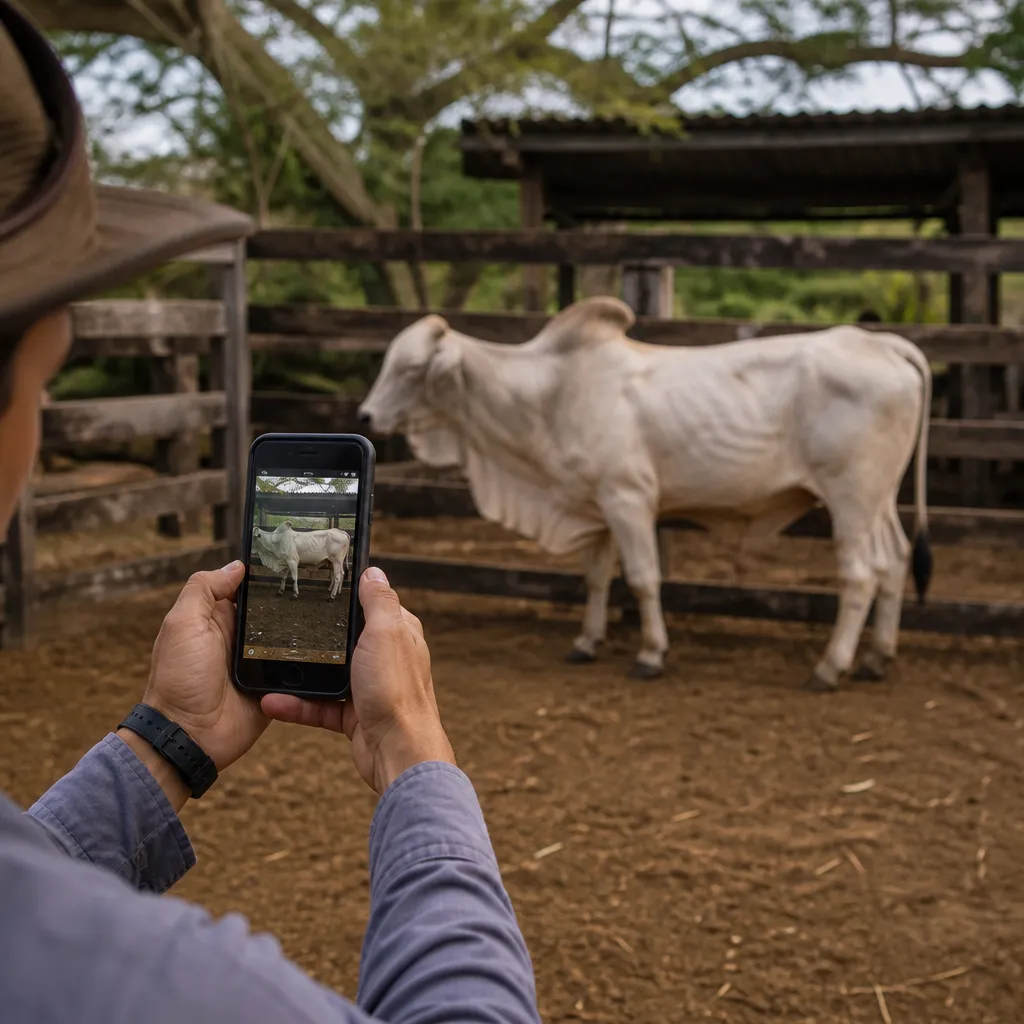
The quality of the photograph is crucial to get accurate estimates, so take the time to learn the correct procedure.Position the animal on a flat, horizontal surface, preferably in a corral or brete where it is quiet and standing naturally. Avoid photographing animals lying, moving or on sloping terrain, as these positions distort the actual dimensions and compromise the result.
Place yourself at a distance that allows you to capture the whole animal in the image, preferably on the right side (standard convention in livestock). The camera should be at the same level as the back line of the animal, not above or below, so that there is no perspective distortion. Make sure that there is good lighting, preferably natural and uniform light, as shadows can interfere with the analysis of the system.
When opening the application, follow the instructions on the screen accurately. Usually you mark specific points on the body of the animal (such as the withers, croup and ribs) or draw a line along the length of the back. The more accurate this procedure, the better the estimate. Some apps allow you to take multiple photos of the same animal at different angles to get an average, further increasing reliability.
After the photograph, you enter additional data in the application, such as race, approximate age and date of measurement. This information helps the system to contextualize the analysis and provide a more accurate result. Some applications even save a history of measurements, allowing you to track the evolution of weight over time and identify trends of gain or loss.
Accuracy and margin of error in practice
You probably want to know: how much error do these apps have? The answer is that the typical margin of error is between 5% and 10%, which means that an animal that actually weighs 500 kilograms can be estimated between 450 and 550 kilograms. For most management decisions in livestock, this accuracy is more than enough. When you need to determine whether an animal is already ready for sale, this margin of error does not significantly affect your decision.
Accuracy improves considerably when you correctly follow all the procedures of photography and measurement. If you photograph the animal always in the same position, at the same time of day and with the same quality of lighting, it creates a consistency that makes the estimates comparable to each other. Even if a single measurement has error, the sequence of measurements will clearly show the tendency of weight gain or loss.
Comparing with fixed scales, mobile applications often have similar or minor errors, especially when we consider that not every farm scale is calibrated correctly.In addition, the error of mobile technology is predictable and systematic, allowing you to account for it in your calculations. What matters in practice is not the absolute error, but the ability to detect significant changes in herd weight over time.
Top apps available for weight estimation
There are several platforms developed specifically for this purpose, and choosing the right one depends on your needs, the type of cattle you raise and your level of familiarity with technology. Some applications work offline after the initial download, which is ideal if you have limited connectivity on the property. Others synchronize in real time with servers in the cloud, allowing you to access your measurements from anywhere and on any device.
Apps like those offered by companies specializing in digital livestock can estimate beef and milk cattle weight, providing results in seconds and automatically saving a history you consult when you need it. Many of these platforms integrate weight estimation with other management tools such as reproductive calendar, sanitary control and feed records, creating a complete ecosystem of property management on your mobile phone.
Before choosing an app, test the free or trial version if available, to ensure that the interface is intuitive for you and that the results make sense with your experience. Read reviews from other breeders and if possible talk to neighbors or colleagues who already use the technology to know which worked best in the context of cattle similar to yours. Investing time in this at the beginning saves frustration afterwards.
Integrating weight estimation into herd management
When you start using weight estimation apps, it’s not enough to just take photos randomly. Develop a consistent protocol: choose specific dates to measure (for example, every 30 days), establish which animals will be followed (perhaps the entire troop or just the cutting males), and create a system to record the data in an organized way. This pattern allows you to compare results over time with confidence.
Use estimated weight data to make concrete management decisions.If you identify that some animals are not gaining weight as expected, adjust the feed, make a more rigorous health assessment or separate them for individualized management. When you see that a batch is ready for sale (reached the desired weight and conformation), schedule the collection in advance, optimizing logistics and reducing animal stress in the final days before transportation.
Share data with your veterinarian or nutritionist if you work with these professionals. Information on weight evolution is valuable for adjusting diets, identifying nutritional deficiencies, and evaluating the effectiveness of vaccination and de-worming protocols.A professional who has access to accurate and systematic data can make much more effective recommendations than just visual observations.
Set weight gain goals for different categories of animal. Growing calves should gain on average one pound per day under proper conditions; confined calves can gain up to 1.5 pounds daily; breeding mothers have smaller gains but need to maintain stable body condition. By comparing actual gain with goal, you quickly identify whether you are on the right track or need to adjust strategy.
Challenges and limitations of mobile technology
Despite the advantages, you should know the limitations to use the technology realistically. Very dirty animals, with mud or crusts covering the body, can impair the visual analysis of the software, resulting in inaccurate estimates. Clean the animal before shooting whenever possible, or if this is not feasible, recognize that the result may have a greater error that day and only use for general reference.
Very young animals (calfs with a few weeks of life) and very obese animals present greater challenges for the algorithm, since their proportions differ greatly from the standard.The software was trained mainly with adult or pre-adult animals in moderate body condition, so get out of the pattern and you can get less reliable estimates. Still, even for these categories, the technology offers a much better approximation than guessing.
Internet connectivity is required at the time of photo capture in many applications, although some work offline with the AI model stored locally on the device. If your property has limited data coverage, make sure that the chosen app can operate without continuous connection.Some systems allow you to shoot offline and synchronize data when reconnecting, giving you the flexibility you need in the field.
Camera quality dependence is also a considerable factor. Very old phones with low resolution cameras may not capture the details needed for accurate analysis. You do not need a top-of-the-line smartphone, but a device with a camera of at least 12 megapixels ensures that the software has enough visual data to work with confidence.
Training and familiarization with the tool
Before using the application throughout your operation, take time to learn the correct technique.Many platforms offer video tutorials, documentation or webinars explaining the procedure step by step. Watch these materials thoroughly and practice several times with some animals before you would depend on the results for important decisions.You can even weigh some animals on a fixed scale on the same day you estimate the app, comparing the results and developing a feeling about the margin of error in your specific situation.
Invite others on your team to learn how to use the tool. The more trained people, the more flexible your operation is and the less you depend on a single person to make the measurements.Standard the procedure among your employees, because small variations in the technique of photography can generate differences in results, and this impairs the comparability between measurements made by different people.
Keep detailed records of all measurements, including date, time, light conditions, name of the application used and important observations (such as whether the animal was very dirty or if there was a problem in the capture). These metadata help you interpret the results later and identify error patterns that can be corrected. After a few months of use, you will have a rich database that allows more sophisticated analysis and adjustments in management strategy.
Comparing results with other methodologies
If you have access to a fixed scale, compare the estimates of the application with actual weighings on various opportunities. Weigh an animal, photograph it with the app on the same day, and compare the results. Repeat this with different animals and at different times, creating a database of validation itself. You will find that the system error is usually consistent (for example, always underestimates by 3%), which allows you to mentally correct the results or adjust the calibration of the application if the platform allows this customization.
Also compare with visual evaluation of experienced professionals. If you work with a consultant or veterinarian who has many years of practice, ask him to estimate the weight looking at the animal, not knowing what was the estimate of the app. Compare the three evaluations (app, visual, and actual weighing if available) to understand where each methodology is stronger. In most cases, the app is in the middle, offering better than pure visual accuracy but with much lower operating cost than fixed scale.
This comparison process is not only for validation: it is also a learning opportunity. You begin to understand which visual characteristics correlate best with actual weight and fine-tune your own visual judgment.Some breeders develop such familiarity with technology that they can predict with relative accuracy what the app estimate will be just by looking at the animal, combining the best of human experience with the objectivity of the machine.
Optimizing your livestock investments with weight data
With accurate weight data collected regularly, you can make much smarter financial decisions.You know exactly when each animal has reached the ideal weight for sale, allowing you to take to the market at the exact moment, avoiding both premature sale (with lower weight and price) and extra time feeding an animal that has already completed its production cycle.In current prices, this optimization can represent significant differences in the annual financial result.
Feeding is typically the highest cost in livestock, so optimizing feed conversion is critical. When you track weight gain over time, you can calculate how many pounds of feed the animal consumed to gain a pound of weight. This metric, called feed conversion, allows you to compare the efficiency of different nutritional strategies and identify which dietary protocols generate the best return on feed investment.
You can also identify and remove unproductive animals faster. If an animal does not gain weight as expected despite having food, water and care equal to the rest of the herd, it may have a genetic or chronic health problem that makes it inefficient. Detecting this early and removing it releases resources for more productive animals, improving the overall result of the operation. Weight estimation technology provides objective data for this decision, preventing you from carrying unproductive animal for months without realizing it.
Future prospects and innovations in livestock monitoring
Weight estimation technology will continue to evolve, likely incorporating additional features that will expand its value. Some systems are already beginning to use artificial intelligence to detect visual signs of disease, identifying, for example, abnormal fluid buildup or changes in hair texture that may indicate parasitism or infection. Infrared cameras and skin temperature analysis are also being explored for early detection of fever.
Drones with high-definition cameras are being tested to capture images of entire herds without the need to drive each animal to a brete. A drone flies over the troop, takes pictures of each animal in standard position, and you get weight estimates for dozens of heads in minutes. This approach further reduces handling time and animal stress, being particularly promising for very large farms.
Integration with wearables (wearable devices) in animals is also trend. Smart necklaces or earrings continuously collect data on activity, heart rate and even metabolites in the body, creating a complete physiological profile. Combined with periodic photo weight estimates, this offers a holistic view of the health and productivity of each animal, allowing truly personalized management at scale.
The general trend is that technology becomes increasingly accessible, more accurate and more integrated with the rest of the production system. For you as a creator, this means that investing in learning to use these tools today is an investment in the future efficiency of your operation. The sooner you start collecting structured data, the more history and insights you will have to make better decisions tomorrow.